
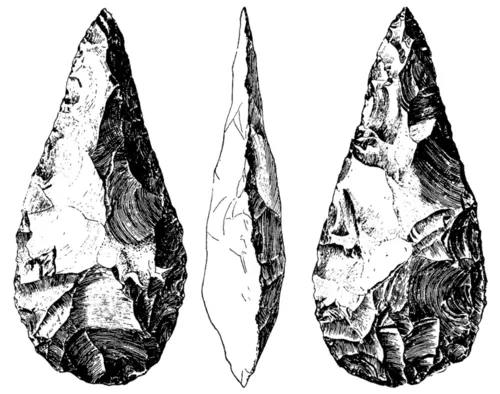
On evolutionary timescales it is not so long ago that we hunted with stone tools, we should not be surprised if much of the way our senses inform our movement and posture patterns has changed little over this time. Please see Eyes Matter – part 1 to find out how our vision affects balance and posture.
Hunter’s Eyes
This is a useful exercise to get your eyes and brain working together in a way that enhances awareness and will often help undo log jams of stress and muscular tension, if you prefer not to think of hunting animals as an early hunter gatherer then you could think of yourself as a wildlife photographer quietly waiting to film a small creature.
The scene, forest, tall trees with 101 hiding places, the ground is not even so you need awareness to walk, there is a whole world above your head in the tree tops, you need to be aware what is happening up there as well. Also remember if you are imagining yourself as a hunter then a larger animal might be eyeing you up at the same time, you cannot afford to get fixated, your awareness needs to be open and wide.
Some people when asked to think like a hunter/photographer will scan the scene with their central, focused vision, moving their eyes around a lot and guessing at possible hiding places anticipating a snout or pair of ears showing from behind a bolder or tree. The problem with this kind of vision is that it is a case of putting all the eggs in one basket we are repeatedly preparing for something happening at this location or that location but it will probably occur somewhere else. If you commit to moving to your left you will find a time lag and level of resistance if you are suddenly and unexpectedly required to move to your right, it’s the same with vision. This style of focused narrow attention triggers our brains into an analytic or cortical style of thinking that is very good at processing one thing at a time in detail but not much good at tracking multiple things happening at the same time.
Another way of seeing is to take in the entire width and height of the scene, full panoramic vision and not to focus on any one thing, (if we do focus on one thing then it will probably be the wrong thing to be looking at when the time comes). Being prepared for anything means being prepared for nothing just quietening the mind and being fully aware. In contrast, investing in a guess at a single outcome sets our intention, narrows awareness and presets our movement system in a way that may be inappropriate for a different outcome, if we are mentally prepared to move left and it turns out we must move right then we have a physical and mental bias that needs to be first overcome before we can act effectively.
Instead we find a quieter, deeper and less analytic part of our mind that is capable of processing many things at once just as long as we stay in wide vision awareness, and trust our system will know what to do when the time comes, we do absolutely nothing to try and make this happen, all we do is stay with wide, non-specific awareness, not to drift and yet not to get fixated on any part of the scene. It’s a more effective approach because our brains have moved from being able to deal only with “one at a time” and can now deal with “all at the same time” just as long as we allow it to happen by leading our mental patterns with our visual pattern of non-specific wide awareness.[1]
Its a matter of trusting lower level, more instinctive parts of our system to do their job and alert us when something moves, this trust is essential. If you have ever noticed a deer looking at you from the corner of your eye when you were not even thinking of deer then you have tapped into this more primeval visual monitoring system.[2]
I don’t recommend that we go around with hunter’s eyes all of the time but it is a useful ‘reset’ button, an antidote to computer eyes and the way to untangling unhelpful habits in the way we use our eyes.
Another Experiment
When you do find yourself committed to a few hours behind the computer screen try the following.
When you are hard at work you may not even be seeing the frame of the screen, you might be focused on one or two words or a small picture so now and then take a minute to allow your vision to come out far enough that you see the whole monitor not just a part of the screen.
Now start to take an interest in the space immediately around the monitor, this is the space your arms and hands might extend into if you decided to pick the monitor up. You don’t necessarily move your head or eyes to do this, instead your central vision takes in the ‘object’ the monitor in this case and your more peripheral vision starts to take an interest and explores the space around the object, this is the space in which you or a part of you like your arm and hand will use if you wish to touch or pick up the object, we can call this your ‘action space’ the space in which you might guide your hands and arms or your whole body around the object of interest in order to pick it up or move it to a different location.[3]
Seeing a whole room in ‘negative’ means trading focus on walls and objects in the room and instead being aware of the shape and volume of the void space between the walls and objects, again this is your ‘action space’ the space that defines your current movement options in relation to your environment.
If you consider this from the perspective of our ancient ancestors, a hunter gatherer it makes perfect sense, a hunter cannot afford to focus exclusively on prey that occupies the centre vision, the hunter needs to be aware of escape routes and obstacles around the prey. In the natural world it is not a good survival strategy to be so immersed with a single object or thing that the surrounding three dimensional environment fades into a blur or becomes two dimensional and yet this is precisely what we do in front of a monitor.
What we really need is a type of visual awareness that allows awareness to fall without effort onto an object but without losing sight of the bigger picture, the space in which the object sits, showing interest in the “what” but also the “where”. [4]
Fell runners experience this kind of visual flow when they run through a path of scree rocks, each one being a potential twisted ankle, and have to allow their vision and system to automatically pick out safe places to place the feet without slowing down their pace, both types of vision work seamlessly together in a flow state.
[1] An interesting aspect of open, non-specific awareness of our surroundings also seems to condition our internal awareness, if our attention is drawn to a specific area in our bodies we will often end up making it more tense, learning how to use the eyes in the hunter’s eyes way can help create a sense of awareness of our entire body that is not focused or judgemental about a particular area.
[2] I usually try and avoid using the term primeval or primitive to refer to the so called ancient parts of our brain in case they somehow sound less important even though we cannot survive without them. Yes those parts of the human brain are the oldest and are associated with survival skills amongst other things but not much in nature stays static, I prefer to suggest instead that all parts of our brains have evolved as required, it’s unfortunate we have adopted naming systems that rank parts of our brain as modern or ancient, they are all working here and now in the 21st century.
[3] Hubert Godard, a French rolfer and body worker came up with the term ‘action space’ to describe the space that is available to us at any given moment, it relates to movement options, in a cluttered room it may be the spaces between furniture, if you are playing football and in possession of the ball it will depend on the movements of players and openings around you. Our hunter gatherer ancestors required this form of spatial awareness as a survival skill.
[4] Vision scientists talk about “what” vs “where”, but as with many western discoveries of this type it was known much earlier in the east. If we learn to see objects without always forming associations or judgments (like, dislike, useful, heavy, light) our balance and visual system can stay wide, our brains don’t fall into analytic “one at a time” processing and so we can use them as reference points to help us locate ourselves in space, something our balance system craves. In contrast, if instead of staying in wide awareness we allow the sight of an object to trigger us into past memories or judgements then our vision system collapses back into narrow focus, our minds narrow back into analytic mode, our brains stop being able to process “all at the same time” and so the task of balancing becomes harder. As our understanding of vision has evolved we have increasingly understood that our brains don’t simply take the output of the eyes and turn it into pictures, our brains interpret the output of the eyes and what we see is as much determined by the brain as the eyes – optical illusions rely on this, going into wide visual awareness or hunter’s eyes changes the way our brains are working and coordinating our movements.