
Unlocking your vision and yourself.
Seeing As If From The Back Of The Head.
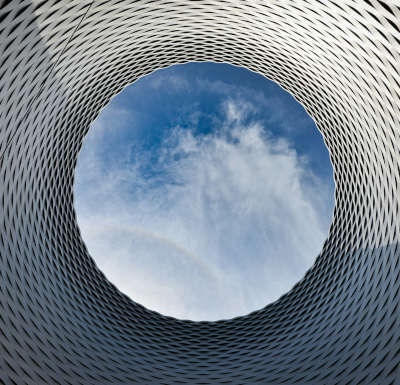
Image: ‘tunnel vision’ an exaggerated impression of the narrow, tightly focused and closed down way of seeing that stressed and tense people experience.
(Before we begin this is about seeing forwards as if from the back of your head)
To try and unpack this rather strange statement, let’s just start by reviewing that the eyes do not actually ‘see’, the eyes take in light, focus it on your retina and convert this to nerve signals, it is your brain that takes those signals and creates meaning and much of the visual processing does actually occur at the back of your head, it is possible that this is a partial explanation for why people over time have discovered this principle (it can be traced back centuries to martial artists and others) but I think there is more to it than this.
I think the benefits of “seeing as if from the back of your head” have a lot to do with the way that we box ourselves in as a reaction to stress and tension, an English philosopher called Douglas Harding described his experiences of becoming aware that he was seeing out as if through two portholes in his skull, this being something that highly stressed people will usually be very familiar with, retreating from the world by metaphorically closing our visual connection down to two port-holes, limiting our sense of being open and immersed in the world.
In his book about stress Douglas asked us to make the shape of a pair of spectacles using our hands.
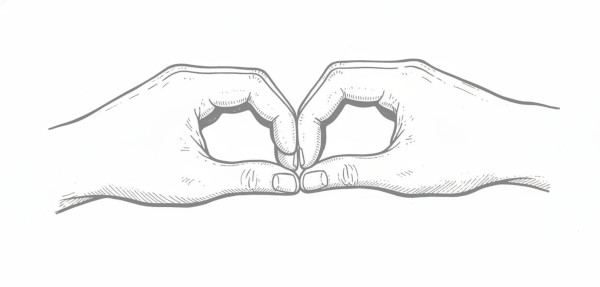
He then asks us to hold these ‘spectacles’ at arms length and whilst looking at them slowly bring the ‘spectacles’ closer to our face, eventually putting them on. Hopefully you found at some stage an impression of the two circles of vision you get when binoculars are badly adjusted and then as you got closer to your eyes you had the impression of only one circle of vision, the two circular frames of your ‘spectacles’ merge into a single circular frame.
People who are feeling stressed often want to withdraw and form a barrier between their internal experience and the unfriendly world out there, it changes in the way they experience vision, it feels safer to be inside their skulls looking through two circular port holes. Of course they may not actually see two distinct circles of vision but subjectively it feels as if the eyes haven’t really united harmoniously it’s still a feeling of being inside looking out rather than being immersed in the world. They may also feel that their vision reaches out like two laser beams as if seeing is something that requires effort, a kind of reaching effort rather than passively allowing the light to come to them.
When we are more relaxed and grounded the vision tends to settle and merge into a single, wide circle of vision, there is less sensation of looking through portholes, the world seems less remote, the vision from the left and right eye is being merged harmoniously, more properly integrated.
Finally when we fully tap into what people mean by “seeing as if from the back of the head” we find that our visual awareness seems to widen and expand again, its as if we have given up the notion of seeing through the front of the face, through the ‘portholes’ of the eyes, instead the subjective experience is as the “barrier to vision” of our skull has disappeared completely and instead we are experiencing the world as if we are immersed directly in the scene.
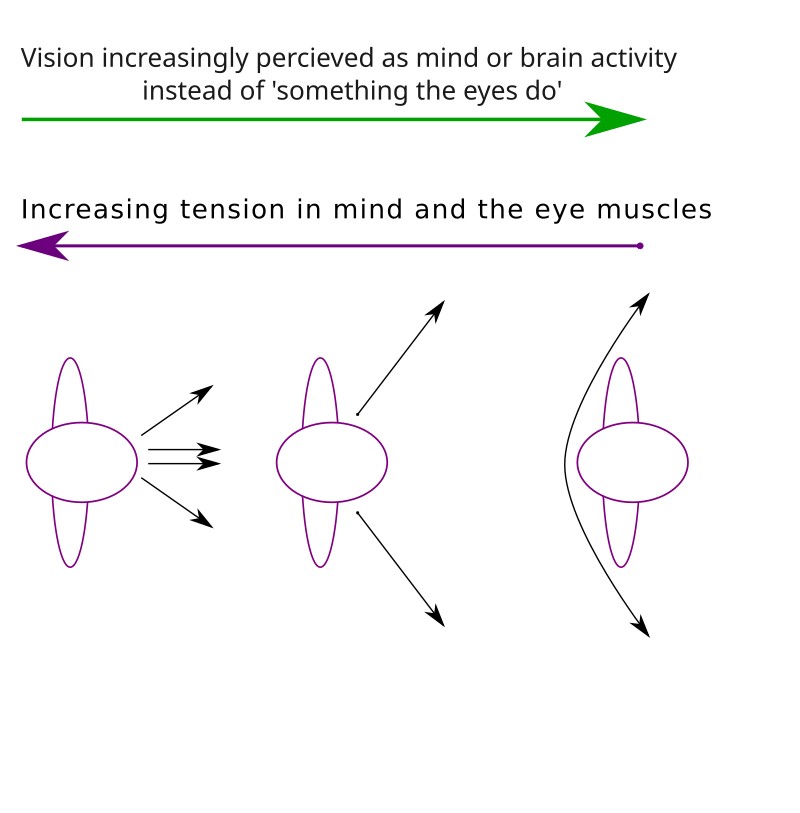
I hope the diagram above helps, we are looking down at someone’s head and shoulders.
The person on the left is quite possibly tense or stressed, their eyes and brain are not quite managing to give a seamless circle of vision, subjectively they may feel they are looking out through two portholes in their face. They may report that their eyes feel hard, in the sense of giving someone a ‘hard look’. The black arrows represent the subjective experience of two narrow, conical fields of vision. A few hours on a computer will often result in this kind of experience.
The person in the middle is enjoying a more integrated experience, subjectively they report only a single well integrated circular field of vision, we are more likely to experience this when on holiday or very relaxed in big open spaces.
The person on the right has let ‘go of their eyes’ it almost seems as if they are no longer playing a major role, instead they are registering the sensation of sight further back in their heads, it seems to them subjectively as if the field of vision has become wider still, it seems more integrated and a much more direct and immersive experience. It almost seems as if they are experiencing a scene that ‘sits’ directly at the top of their spine, as if the eyes have become redundant because they are experiencing the scene as if they are part of it. This immersive sense can be taken a step further by thinking of your awareness as being roughly 180 degrees at the front and using your ears as if to sense behind you giving a full 360 degrees of sensory awareness.[1]
It’s difficult to describe this without sounding “woo woo” but remember that the world we experience is what our sensory organs and brain create for us, vision, hearing, taste, smell are the sensations our brain makes for us according to whatever our sensory organs are picking up. Our mental state and tensions whether contracted or free and open can have a profound effect on the way we experience the world and can help relieve stress and tension or amplify it. So this more immersive way of experiencing the world is really what people subjectively experience when tensions are removed, when we take off the restrictive ‘blinkers’ off and release stress and tension.
As a final takeout try comparing two experiences as follows, you may find the first less pleasant than the second.
First: Move your centre of awareness, forwards into your high chest and find your feeling of where vision ‘happens’ right into the front of your face, almost as if your eyes are reaching out into the world hungry to grab light and pull it in – please don’t do it for long though because most people find it unpleasant and stressful, you may experience tension at the back of the neck and start going into “text neck” posture.
Second: Then contrast the first part of the experiment with moving your sense of where you are, further back in yourself, be more in your own back[3], think of seeing the world from a position further back in your head, free your eyes, let go of them and allow your vision to go wide, allow your face to ‘open’ or be transparent to the world without worrying too much about what that means.
Start being aware of the outer areas of your vision from side to side and from top to bottom, not by moving your eyes but just letting your visual awareness grow and expand, it will be fuzzy at the edges but that is perfectly fine, your balance system uses peripheral vision for positional markers.
It doesn’t matter if a particular positional marker used by your balance system as a marker is a red bucket or a puddle of splashed red paint on the floor and if it is in your peripheral vision then it may be too fuzzy for you to tell, the visual cortex pathway that serves your balance system does not care “what that red patch is” but it does care “where that red patch is”.
These visual cues don’t require any special effort on your part, you don’t need to actually select visual markers, your brain will effortlessly do this for you just as long as you don’t go “tunnel vision” and instead you choose a wide, immersive awareness, this type of awareness signals the motor systems in your brain that you may wish to move and so your balance system wakes up.
- Release any effort that you may be making to reach out with your eyes, be passive, let the light to come to you.
- Release the muscles in and all around your eyes allow them to soften – seeing does not take physical or mental effort.
- Start to tune your awareness of the space behind you rather than lurching all the time into the space in front of you, be “back in yourself” and be in the present moment, not the past or the future but now[2].
Hopefully you found the second part of this experience much nicer and calmer than the first, did you have a greater sense of the space that you inhabit? being present in this moment rather than pushing forwards with your will or sense of duty into the future? Our senses tend to shut down whenever we dwell in the past or the future, your balance system works best when you come back to your own back and come back to this present moment.
Please avoid vision experiments whilst driving or operating machinery.
[1] Again on the theme of our ancestral origins as hunter gatherers, we probably relied on a very highly developed 360 degree sense of awareness, successful hunting is being able to spot camouflaged or hidden prey but survival demands you are aware all the time of being a hunter and not becoming the hunted. Using the sense of hearing to cover the zone behind us makes perfect sense. This is well know to Tai Chi masters…
“A simple way to help you align your head properly is to look straight ahead at the horizon and listen backwards behind the head” – Master Max Gaofei Yan (Tai Chi Master) – What Is Chi – p163 – Master Max Gaofei Yan and Jude Brady Smallwood.
[2] It is not just a metaphor that the future lies in front of us, we tend to press ourselves into our chest and face when we try to deal with things that haven’t happened yet and so anxiety and worry manifest themselves as “forward lurching tensions” in the front of our bodies.
Of course imagined futures are not yet part of the real world and so in order to visit them within our mental narrative we abandon ourselves in the present moment and so lose our sense of embodiment in the here and now, our balance and postural systems go into idle mode, some parts of us tense up to compensate for our compromised balance and so we crumple and start feeling uncomfortable and in the extreme case of a panic attack we may suffer giddiness.
[3] It is no coincidence that people say things like “I’ve got your back” or “You can count on our support, we are right behind you” or “I am backing you” – in order to feel secure and open to the world in front of us it helps us enormously to feel the support and confidence of a strong and expanding back, being “back in ourselves” gives us the security and anchorage to be open and receptive to the world in front.