
You don’t need to prepare for an Alexander Lesson, simply turn up, an AT teacher takes people as they are, you don’t need to be particularly fit, if you have aches and pains or you feel sensitive about posture then just come as you are. Long sleeves are preferable, an Alexander Technique teacher works with their hands on a layer of clothing.
The teacher has learnt a skilled use of their hands in a way that people find almost like a communication, the teacher will usually supplement this with words as well, the teacher uses their hands to show you new ways of connecting and integrating your entire being whilst in motion or at rest. The teacher is also identifying unhelpful patterns that you may not realise are interfering with the smooth fluidic motion that would otherwise be able to emerge.
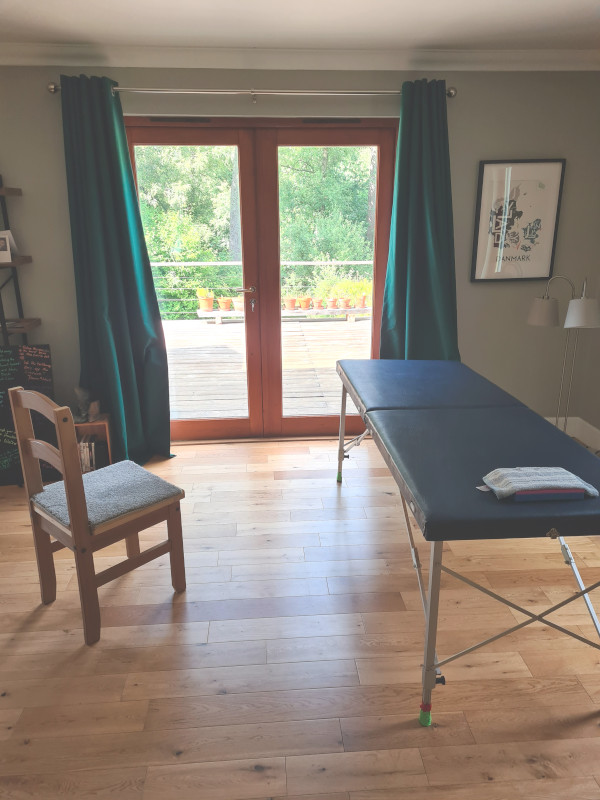
Image above: This is my main teaching room in Dolphinton.
Chair Work
In chair work I work with the client whilst they are seated but periodically guide them in and out of the chair to a standing position. Although this may seem like a very specific activity to explore and there is certainly a value in exploring how we get in and out of a chair, but really it is a window into something far more general and that is how the client looks after the relationship between their head neck and torso during movement.
Absolutely core to the Alexander Technique is consideration of the spine, the neck which is of course part of the spine the head and pelvis. When people are tense or stressed they typically pull their head back and down and this leads to a wider pattern of unproductive contraction that affects the whole spine, the torso, the hip joints and the legs and arms. In fact every part of you affects every other part, this has been known for a long time by Tai Chi masters but is often neglected in the west.
Sometimes a client is unable to do chair work, or perhaps they are simply tired and in such cases we might focus on table work where the client lies down instead.
Table Work
During table work the client will typically be on a massage table in a lying down position known as semi-supine with the knees raised.

One of the advantages of table work is that it reduces the role of gravity which many people when they first arrive for lessons are experiencing as an adversary, something that makes them feel pulled down and heavy, this often makes it easier for clients to start to experience the sensations of feeling expanded as if their joints are opening up, clients may start to notice the difference between their habitual levels of tension and how their bodies feel when those tensions start to melt away.